Most people know the Norse gods from films these days. The old stories are rougher, stranger and often funnier. Below are the Norse pieces from our mythology collection and the stories behind them. First a word on where those stories come from, because it explains a lot.
Where the stories come from
Almost everything we know about the Norse gods is in two books from Iceland. The first is the Prose Edda, written around 1220 by the Icelandic scholar and politician Snorri Sturluson, as a handbook for poets who wanted to understand the old imagery. The second is the Poetic Edda, a collection of older poems in a single manuscript from around 1270, the Codex Regius. That manuscript turned up in 1643 in the possession of an Icelandic bishop.
Iceland had become Christian in the year 1000. The writers who recorded the stories did so more than two centuries after anyone still worshipped the gods. They were Christians preserving an old heritage. That is why we know a lot about the stories and little about how people actually worshipped the gods.
Odin
The chief god, god of wisdom, poetry, magic and death in battle. He is a god who always wants to know more and will pay anything for it. Under one of the roots of the world tree Yggdrasil lies the well of Mímir, which holds all wisdom. Odin gave an eye for a single drink from it. In the poem Hávamál he tells how he hung for nine nights on the world tree, wounded by his own spear, "myself given to myself", without food or drink, until he saw the runes and took them up screaming.
Two ravens fly over the world every day and tell him what they see: Huginn, thought, and Muninn, memory. In another poem Odin says he fears Huginn may not return, but fears more for Muninn. He rides Sleipnir, an eight-legged horse, and in Valhalla he gathers fallen warriors for the last battle. Wednesday is named after him, Woden's day.
His end is fixed. At Ragnarök, the end of the world, he is swallowed by the wolf Fenrir. His son Víðarr avenges him by tearing the wolf's jaws apart.
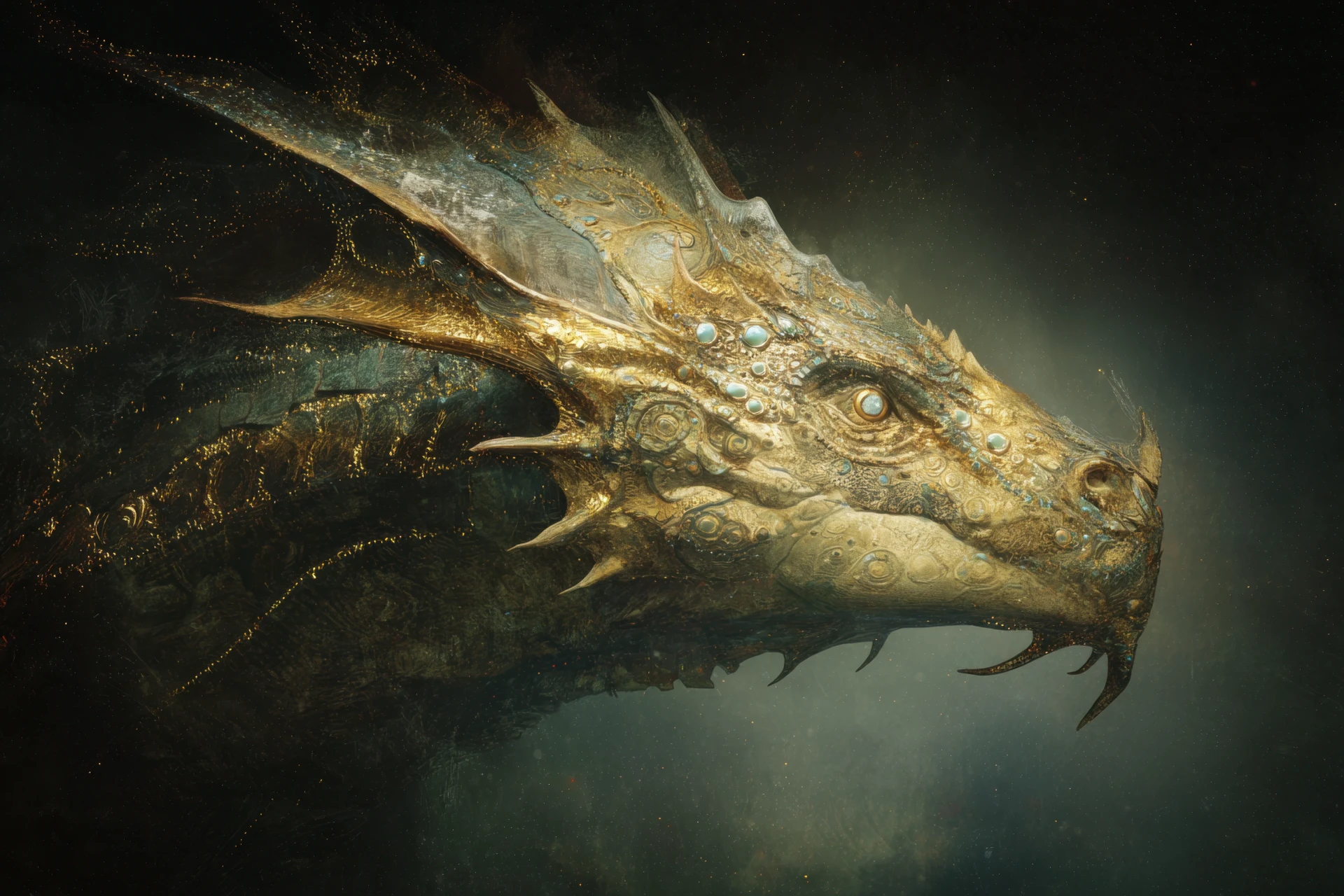
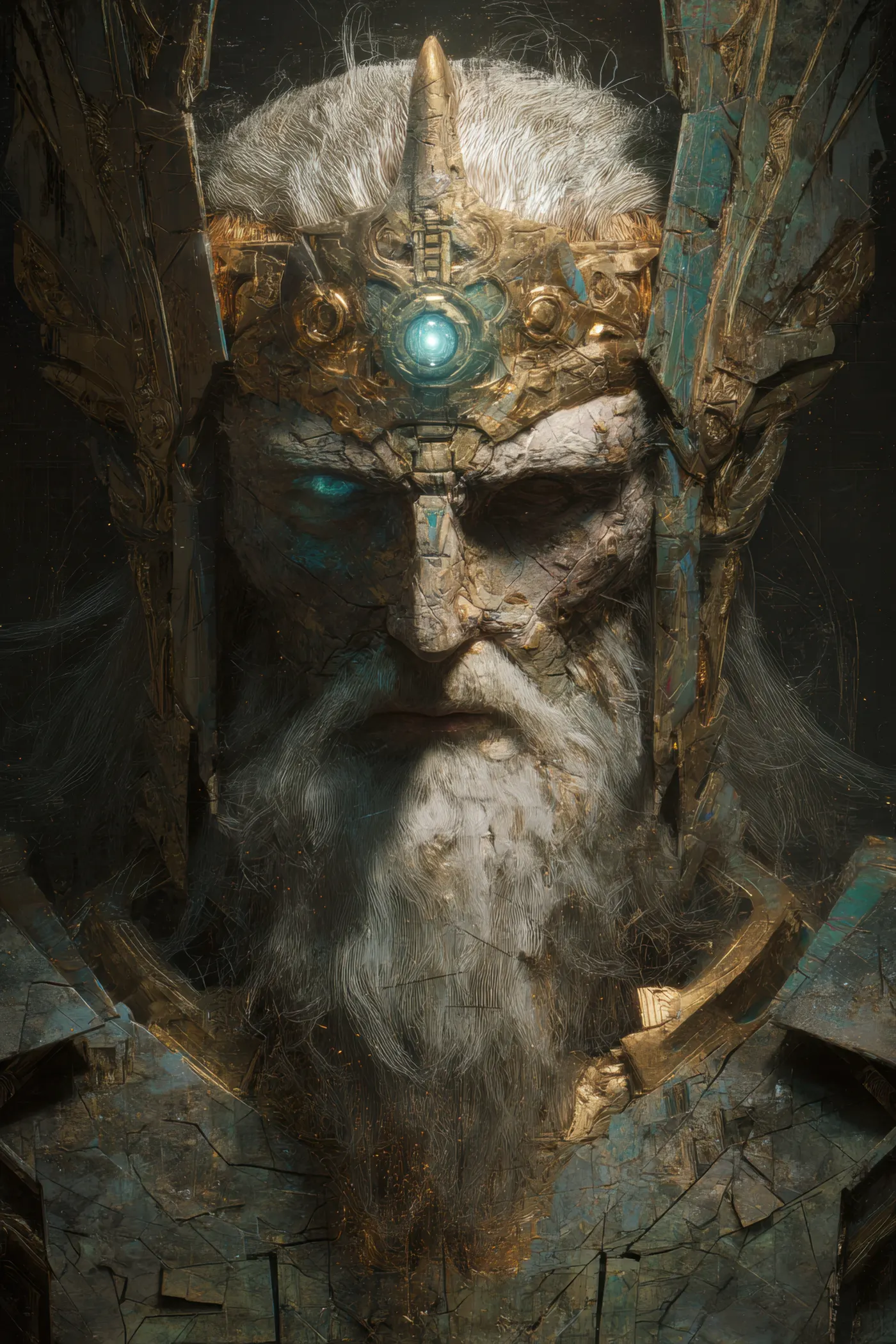
In Odin that single eye glows blue. It is weathered gold and stone, with a lot of darkness around it.
Thor
Son of Odin, god of thunder and protector of gods and people against the giants. Where Odin is cunning, Thor is straightforward: strong, short-tempered and with an endless appetite. Among ordinary people he was probably the most popular god. Many small hammers worn as amulets have been found from the Viking Age, possibly as a counterpart to the small cross Christians wore.
His hammer Mjölnir was forged by two dwarves, Brokkr and Sindri, after a bet with Loki, who had wagered his head. To make the dwarves fail, Loki turned into a fly and stung Brokkr on the eyelid while he worked the bellows. That is why the handle came out too short. The dwarves won anyway, but Loki saved his head with a quibble: they could have his head, but not his neck.
The funniest story is the poem Þrymskviða. The giant Þrymr steals the hammer and will only return it if he may marry Freya. Freya refuses in a fury. So Thor goes himself, dressed as the bride, with Loki as bridesmaid. At the wedding feast the bride eats a whole ox and eight salmon and drinks three casks of mead. Loki explains that the bride has not eaten for eight nights out of excitement. When the hammer is laid in the bride's lap to bless the marriage, Thor grabs it and kills the whole wedding party.
At Ragnarök Thor kills the Midgard Serpent, the giant snake that lies around the world, takes nine steps and falls dead from its venom. Thursday is named after him, Thor's day. Thor is shown full length, hammer raised and lightning running down his arm.
Loki
The trickster, and the strangest figure of them all. He is the son of a giant but lives among the gods and is Odin's blood brother. He can change his shape and helps the gods as often as he gets them into trouble. When a giant built the wall around the gods' stronghold and demanded Freya as payment, Loki turned into a mare to lure away the builder's stallion. From that, Sleipnir was born, Odin's eight-legged horse. Loki is, in other words, the mother of Odin's horse.
With the giantess Angrboða he had three children: the wolf Fenrir, the Midgard Serpent and Hel, who rules the realm of the dead. His story turns with the death of Baldr, Odin's beloved son. Baldr's mother Frigg had made everything in the world swear not to harm him, except the mistletoe, which seemed too young to her. Loki gave a sprig of mistletoe to Baldr's blind brother Höðr and helped him aim.
His punishment is gruesome. He is bound to three stones with the entrails of his own son. Above his face hangs a serpent dripping venom. His wife Sigyn catches it in a bowl, but when she goes to empty it, the venom falls on his face. His convulsions are the earthquakes. There is, by the way, no trace that anyone ever worshipped Loki: no place names, no offerings. He exists only in the stories.
Loki is a bust in black marble with a golden horned helmet. That helmet does not come from the old stories. The image of the horned Viking began in 1876, when costume designer Carl Emil Doepler dressed the singers in Wagner's Ring of the Nibelung that way. The only nearly complete helmet from the Viking Age, the Gjermundbu helmet from Norway, has no horns. Our piece is Loki as the nineteenth century saw him.
Fenrir
The giant wolf, a son of Loki. The gods took him in to keep an eye on him, but only Týr dared to feed him. Fenrir grew so fast that they became afraid. They tried to bind him with the chain Leyding, which he broke, and then with Dromi, twice as strong. He broke that too.
Then they had the dwarves make a fetter: Gleipnir, thin and soft as a silk ribbon, made of six things that do not exist. The sound of a cat's footfall, the beard of a woman, the roots of a mountain, the sinews of a bear, the breath of a fish and the spittle of a bird. Snorri adds drily that this is why you no longer find any of those things.
Fenrir did not trust the ribbon. He would only let himself be bound if one of the gods put a hand in his mouth as a pledge. Týr did. The ribbon held, Fenrir could not get free, and Týr lost his hand. The gods wedged a sword between the wolf's jaws; his drool became a river. So he lies until Ragnarök, when he breaks loose and swallows Odin.
In Fenrir the wolf wears a mask of gold and blue stone, the head in profile, cool in colour and heavy in detail.
Freya
Goddess of love and fertility, but also of battle and of seiðr, a kind of magic and prophecy that, according to tradition, she taught to Odin. She does not originally belong to the Æsir, the group around Odin, but to the Vanir, a second family of gods. After a war between the two groups she came to the Æsir as a hostage with her father Njörðr and her brother Freyr, and she stayed.
She rides a chariot drawn by two cats, owns a cloak of falcon feathers that lets you fly, and wears the necklace Brísingamen. When her husband Óðr is away travelling, she weeps tears of red gold. Half of the fallen come to her, to her hall Fólkvangr; the other half go to Odin.
Friday is often credited to her, but is probably named after Frigg, Odin's wife. Whether Frigg and Freya were once one goddess, scholars do not agree. Freya is a pale portrait in profile, with braids and a fine crown, in warm grey, almost without colour.
The valkyries
The name literally means "choosers of the slain". In the later stories they are shield maidens who ride over the battlefield and carry fallen heroes to Valhalla, where they pour their mead. In older texts they are grimmer. In the poem Darraðarljóð, preserved in Njál's saga, twelve valkyries work at a loom with human heads for weights and entrails for yarn, and so weave the outcome of a battle.
The best known valkyrie is Brynhildr, who let a king win against Odin's will and was put to sleep behind a wall of fire as punishment. Her story lives on in Wagner's operas, and with it the image of the valkyrie with wings on her helmet. Like Loki's horned helmet, that comes from the nineteenth century. Valkyrie shows a shield maiden in dented silver, with golden wings on her helmet and the battlefield faint behind her.
Not a god, but Norse: the kraken
The kraken does not come from the Eddas. It appears much later, in Norwegian folk belief about sea monsters, and became famous through Erik Pontoppidan, bishop of Bergen, who described it in 1752 and 1753 in his natural history of Norway: a creature so large that fishermen mistook it for an island. A sighting of a giant squid was probably behind it. The Kraken in the black and white series shows only the arms rising from the water; the rest stays dark.
For the gods of the south: Egyptian gods in the collection.