The Egyptian gods are easiest to recognise by their heads: a falcon, a jackal, a cat. Who they were, and why they wear those heads, is less well known. Below are the gods from our mythology collection, with the story behind each piece.
Horus
The falcon-headed god, lord of the sky and protector of the pharaoh. He was the son of Osiris and Isis. When Osiris was murdered by his brother Set, Horus fought Set for the throne. In that fight he lost an eye, which was later restored. That eye, the Eye of Horus, became one of the best known protective symbols of Egypt.
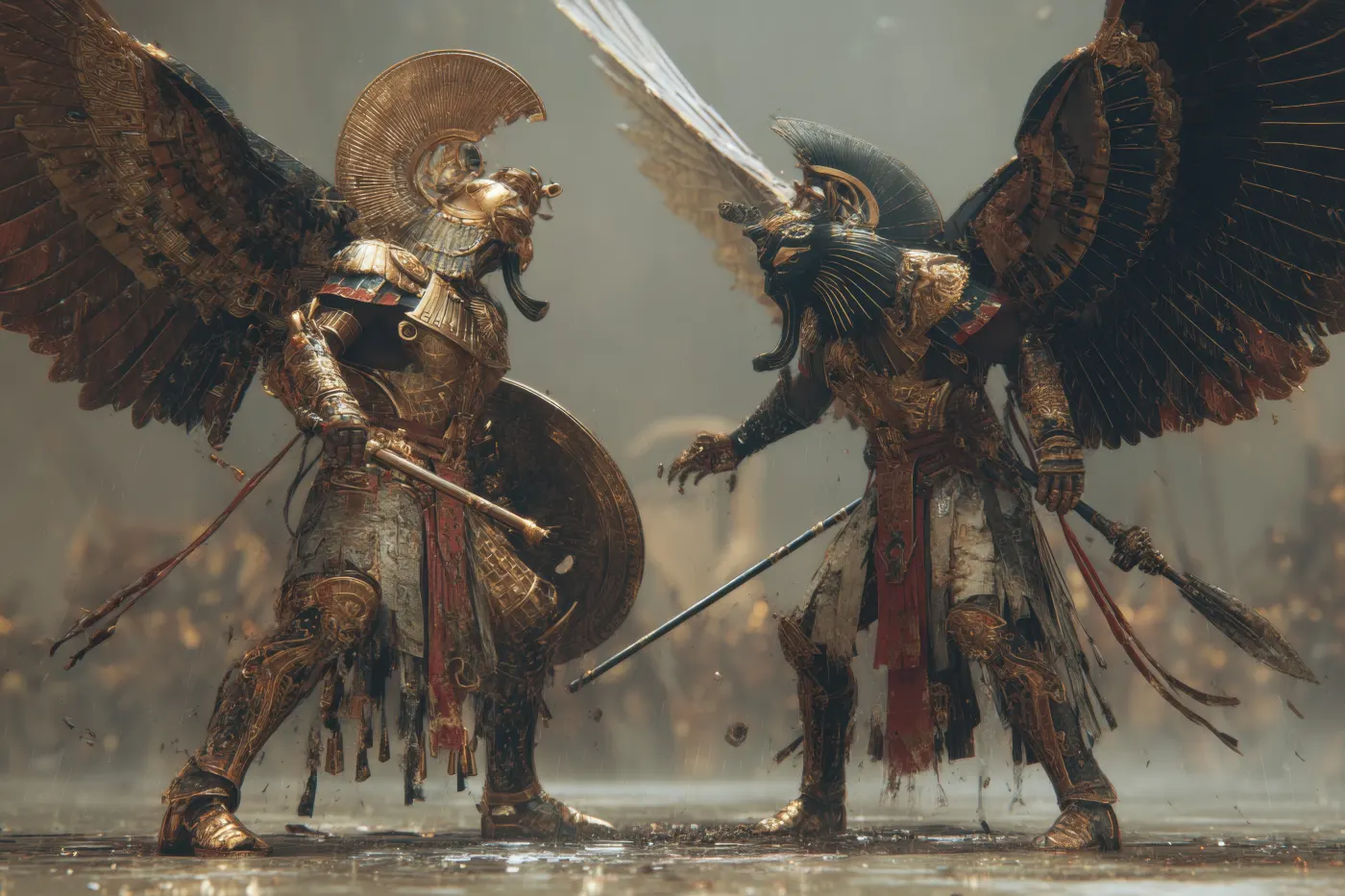
He appears three times in the collection: Horus, ceremonial, still and upright in full regalia; Horus in flight, wings outstretched; and in battle with Set.
Set
God of the desert, storms and disorder. In the stories Set stands for everything outside the ordered world. His struggle with Horus is one of the oldest stories we know. Set against Horus shows the moment of impact.
Anubis
The jackal-headed god, guardian of the dead. He presided over embalming and led the dead into the afterlife. In the Book of the Dead he weighs the heart of the deceased against a feather. In Anubis and Horus jackal and falcon stand side by side, as equals.
Bastet
The cat goddess, protector of the home and the family. Her main temple stood in the city of Bubastis, where cats were revered and embalmed after death. Bastet stands in full regalia before a golden disc.
Sekhmet
Bastet's fierce counterpart: a lioness, goddess of war and of disease and healing. In a well-known story the sun god Ra sent her against mankind. When she could not be stopped, she was tricked with beer dyed red like blood. She drank until she fell asleep. There are two pieces: Sekhmet, frontal and close, and Sekhmet in armor.
Thoth
The ibis-headed god of writing, knowledge and the moon. He was credited with inventing hieroglyphic writing. At the weighing of the heart he records the outcome. Thoth is shown close up, with a collar of hammered gold.
The sphinx
A lion's body with a human head, a guardian of temples and tombs. The best known one lies at Giza. Our Sphinx with two heads is a free variation on it; the Sphinx from below stays closer to the original.